AI Neural networks
Created:
Updated:
Categories: AI: Artificial intelligence
Author: Tobias Schottstädt
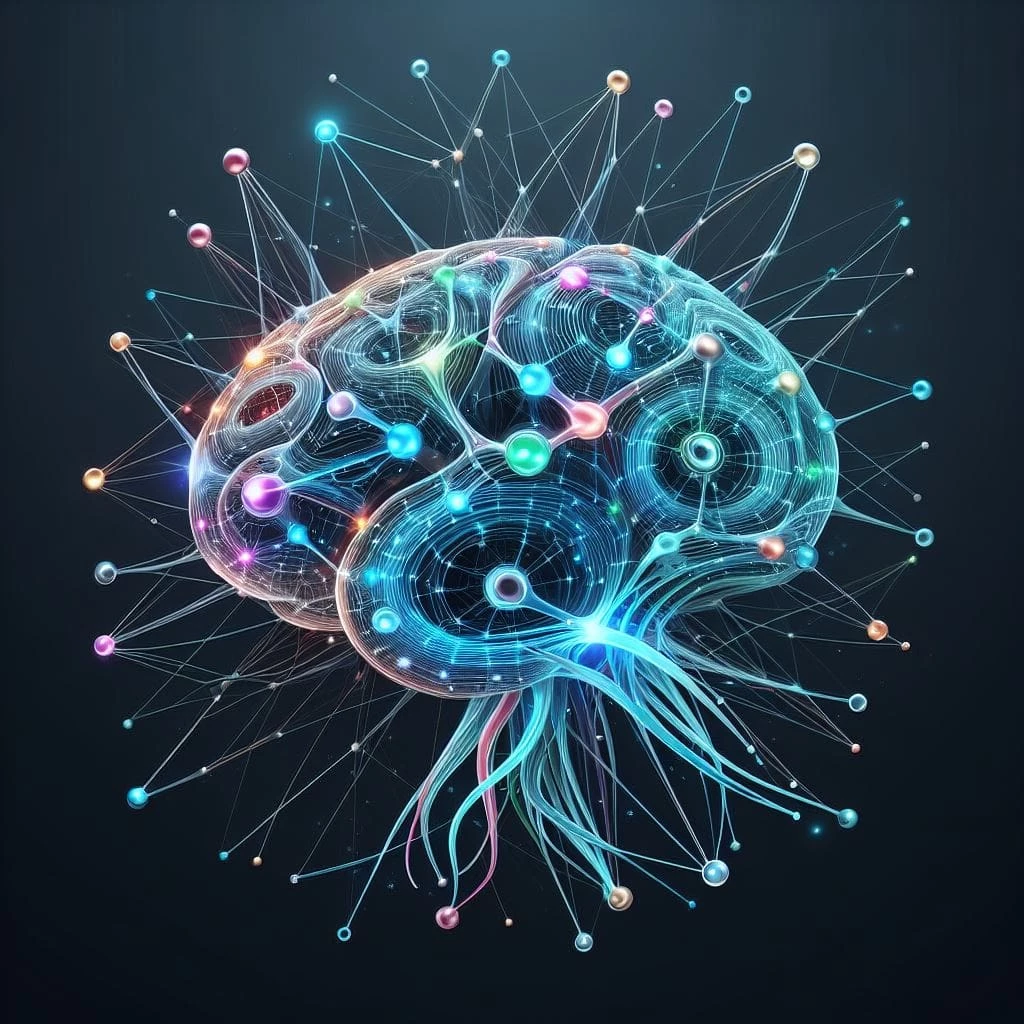
Neuronal networks are a core concept of machine learning and artificial intelligence. They are inspired by the biological brain and consist of artificial neurons that are arranged in layers and process information.
Table of contents:
- II. structure of a neural network
- III. activation functions
- IV. Learning algorithms for neural networks
- V. Applications of neural networks in the business environment
- VI. challenges and future of neural networks
- II. structure of a neural network
II. structure of a neural network
A neural network consists of different layers, including an input layer, one or more hidden layers and an output layer. Each neuron in one layer is connected to neurons in the next layer and transmits information using weights and activation functions.
III Activation functions
Activation functions are mathematical functions that are applied to the weighted inputs of a neuron to determine its activation. They indicate whether a neuron is activated and how strongly it responds. Common activation functions are the sigmoid function, the ReLU function and the tangent hyperbolic function.
<
IV. Learning algorithms for neural networks
Learning algorithms are methods that enable neural networks to learn from data and adapt their weightings to generate the desired output. Commonly used learning algorithms include the backpropagation method and different variants of gradient descent.
V. Applications of neural networks in the business environment
Neuronal networks are used in various business areas, including image recognition, speech recognition, predictive analytics, financial modelling and recommendation systems. They help companies to analyse data, identify patterns and make informed decisions.<
VI. challenges and future of neural networks
Although neural networks are powerful tools, they also face challenges such as overfitting, insufficient training data and interpretability of results. The future of neural networks will be characterised by advances in research, the development of new architectures and integration with other technologies. It is crucial to address these challenges in order to realise the full potential of neural networks.

Author
Hey 👋 my name is Tobias Schottstädt and I am a full-stack developer. As a ki specialist from Kassel I may be able to support you in your project. I look forward to hearing from you! Whether you have questions, suggestions or feedback. About me | Contact
My main focus is on application development, which I realize mainly with the programming languages PHP and JavaScript, using the frameworks Laravel and Vue.js or Livewire.